
What Does Polis Mean?
Quick Definition
The polis meaning refers to an independent Greek city-state that served as both a city and a self-governing political community.
Most Common Meaning
A polis was:
- A city
- Its surrounding territory
- Its citizens
- Its government
- Its laws
- Its institutions
Unlike a modern city, a polis was considered a complete political entity.
Key Characteristics
A polis typically included:
- Independent government
- Defined territory
- Citizens
- Public institutions
- Military defense
- Religious centers
Pronunciation of Polis
The word is commonly pronounced:
POH-liss
IPA pronunciation:
- /ˈpɒlɪs/ (British English)
- /ˈpɑːlɪs/ (American English)
The emphasis falls on the first syllable.
Origin of the Word Polis
The polis meaning comes from the Ancient Greek word πόλις (pólis), meaning city or city-state.
From this root came many modern English words, including:
- Politics
- Political
- Policy
- Metropolitan
- Cosmopolitan
The concept of the polis strongly influenced Western political thought.
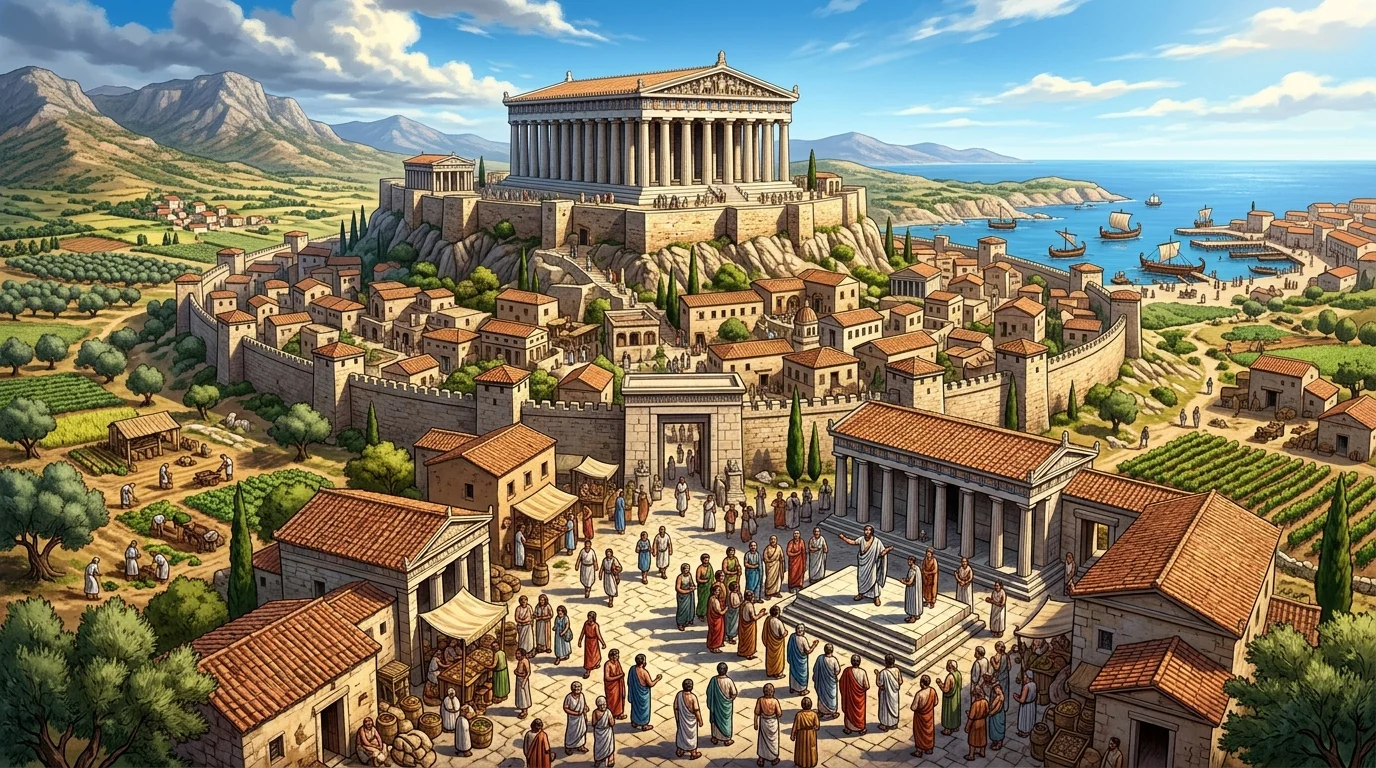
Polis Meaning in Ancient Greece
The polis meaning is central to Ancient Greek civilization.
Rather than belonging to one country, Greeks usually identified themselves by their own polis.
For example:
- Citizens of Athens identified as Athenians.
- Citizens of Sparta identified as Spartans.
Each polis functioned independently and often competed or allied with others.
Main Features of a Polis
The polis meaning included several defining features.
Independent Government
Each polis governed itself.
Political systems varied and included:
- Democracy
- Oligarchy
- Monarchy
- Tyranny
Citizenship
Only recognized citizens participated fully in political life.
Acropolis
Most poleis included an acropolis, a fortified hill that served as a religious and defensive center.
Agora
The agora was the public marketplace and gathering place for commerce and political discussion.
Military
Each polis maintained its own military for defense and warfare.
Famous Greek Poleis
Several city-states became especially influential.
Athens
Known for:
- Democracy
- Philosophy
- Art
- Education
Sparta
Known for:
- Military discipline
- Warrior culture
- Strong army
Corinth
Known for:
- Trade
- Wealth
- Strategic location
Thebes
Known for:
- Military strength
- Regional influence
Each polis developed its own unique identity.
Polis and Democracy
The polis meaning is closely connected to the history of democracy.
Athens developed one of the earliest known democratic systems.
Citizens participated by:
- Voting
- Debating laws
- Holding public office
- Serving on juries
Although participation was limited compared to modern democracies, the Athenian polis influenced political systems around the world.
Daily Life in a Polis
Life in a polis centered on community participation.
Citizens were expected to:
- Attend public meetings
- Defend the city
- Worship local gods
- Participate in festivals
- Follow civic laws
The polis shaped nearly every aspect of daily life.
Influence of the Polis Today
The polis meaning continues to influence modern society.
Its legacy can be seen in:
- Democratic government
- Civic participation
- Political philosophy
- Public institutions
- Urban planning
Many modern political concepts trace their origins to the Greek polis.
Examples of Polis Meaning
Example 1
Person A: What does polis mean?
Person B: It refers to an independent city-state in Ancient Greece.
Meaning: Basic definition.
Example 2
Person A: Was Athens a polis?
Person B: Yes, it was one of the most famous Greek city-states.
Meaning: Historical example.
Example 3
Person A: Why is the polis important?
Person B: It shaped early ideas about citizenship and government.
Meaning: Political significance.
Example 4
Person A: Did every polis have its own government?
Person B: Yes. Each one governed itself independently.
Meaning: Self-government.
Example 5
Person A: What was the agora?
Person B: It was the marketplace and public meeting area within a polis.
Meaning: Civic center.
Common Misunderstandings About Polis
Polis Was More Than a City
The polis meaning includes the government, citizens, and surrounding territory—not just buildings.
Ancient Greece Was Not One Unified Country
It consisted of many independent poleis.
Not Every Polis Used Democracy
Different city-states adopted different forms of government.
Related Terms
| Term | Meaning |
|---|---|
| Acropolis | Fortified hill within a Greek city |
| Agora | Public marketplace and meeting place |
| Citizen | Member of a polis with political rights |
| Democracy | Government by the people |
| Oligarchy | Rule by a small group |
| Sparta | Famous military polis |
| Athens | Famous democratic polis |
| City-State | Independent political city |
Is Polis Positive, Negative, or Neutral?
The polis meaning is generally neutral.
Historically, it describes a political organization.
Many scholars view the polis positively because of its influence on democracy, philosophy, citizenship, and Western political thought.
Related posts:
 Miles Name Meaning Origin, History, Personality Traits & Popularity (2026)
 Best CW Meaning Definition, Social Media, Texting, Medical & Other Uses (2026)
 Best Salad Days Meaning Definition, Origin, Shakespeare, Examples & Complete Guide (2026)
 Scarab Meaning Symbolism, Ancient Egypt, Spiritual Significance & Complete Guide (2026)