
What Does Kinship Mean?
Quick Definition
The kinship meaning refers to relationships between people based on family connections, marriage, or culturally recognized family ties.
Most Common Meaning
In everyday language, kinship usually means:
- Family relationships
- Blood relatives
- Connections through marriage
- A sense of belonging within a family
Key Characteristics
Kinship often involves:
- Family connections
- Shared ancestry
- Marriage relationships
- Mutual support
- Social responsibilities
Origin of the Word Kinship
The kinship meaning comes from the Old English word kin, meaning family, relatives, or lineage.
The suffix -ship indicates a state, condition, or relationship. Together, kinship literally means the state of being related.
Over time, the word became an important concept in anthropology, sociology, and family studies.
Types of Kinship
The kinship meaning includes several kinds of relationships.
Blood Kinship (Consanguinity)
These relationships are based on biological descent.
Examples include:
- Parents
- Children
- Brothers
- Sisters
- Grandparents
- Cousins
Kinship Through Marriage (Affinity)
These relationships arise through marriage rather than blood.
Examples include:
- Spouse
- Mother-in-law
- Father-in-law
- Brother-in-law
- Sister-in-law
Adoptive Kinship
Many societies recognize family relationships created through legal adoption.
Adoptive parents and children are considered family members even without biological ties.
Fictive Kinship
Some cultures recognize close relationships that function like family even though there is no blood or legal connection.
Examples include:
- Godparents
- Close family friends treated as relatives
- Community elders regarded as family
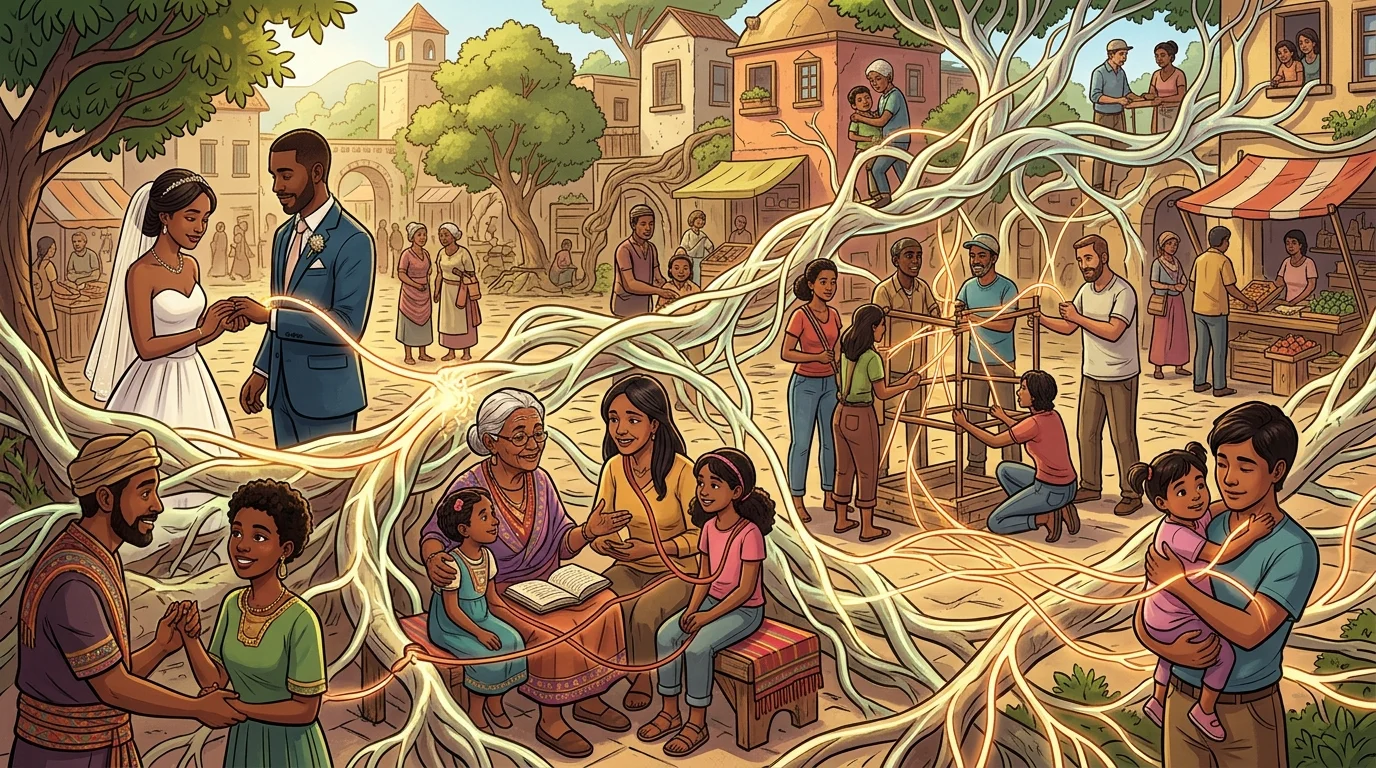
Kinship Meaning in Anthropology
In anthropology, the kinship meaning extends beyond immediate family.
Researchers study kinship to understand:
- Family organization
- Marriage systems
- Inheritance
- Social roles
- Cultural traditions
- Community structure
Different societies define family relationships in different ways.
Kinship Meaning in Sociology
Sociologists examine kinship because it influences:
- Social support
- Identity
- Economic cooperation
- Childcare
- Family obligations
- Social stability
Kinship networks often help people through major life events.
Kinship in Everyday Life
The kinship meaning is not limited to academic discussions.
People often use the word to describe:
- Strong family bonds
- Feelings of belonging
- Shared heritage
- Emotional closeness
Example:
“I felt an immediate sense of kinship with them.”
Here, kinship refers to a feeling of connection or similarity.
Importance of Kinship
Kinship remains important because it helps provide:
- Emotional support
- Family identity
- Cultural traditions
- Care for children
- Assistance during difficult times
- Shared responsibilities
In many cultures, kinship relationships influence daily life, celebrations, and decision-making.
Examples of Kinship Meaning
Example 1
Person A: What does kinship mean?
Person B: It refers to family relationships and connections between relatives.
Meaning: Basic definition.
Example 2
Person A: Why is kinship important?
Person B: It helps strengthen families and communities.
Meaning: Social importance.
Example 3
Person A: Are in-laws part of kinship?
Person B: Yes, they are related through marriage.
Meaning: Affinal kinship.
Example 4
Person A: What is blood kinship?
Person B: Relationships based on biological descent.
Meaning: Consanguinity.
Example 5
Person A: I felt a kinship with the group.
Person B: You felt a strong sense of connection.
Meaning: Emotional closeness.
Common Misunderstandings About Kinship
Kinship Isn’t Only About Blood Relatives
Many cultures recognize marriage, adoption, and socially accepted family relationships as part of kinship.
Kinship Differs Across Cultures
Different societies organize family relationships in different ways.
Kinship Can Describe Emotional Connection
In everyday English, people sometimes use the word to express a feeling of closeness even without a family relationship.
Synonyms and Related Terms
| Term | Meaning |
|---|---|
| Family | Group of related people |
| Relatives | Family members |
| Lineage | Family ancestry |
| Ancestry | Family descent |
| Heritage | Cultural and family background |
| Relationship | Connection between people |
| Clan | Extended family group |
| Household | People living together |
Is Kinship Positive, Negative, or Neutral?
The kinship meaning is generally positive because it is associated with:
- Family support
- Belonging
- Unity
- Shared identity
- Cooperation
- Cultural continuity
However, the word itself is neutral and simply describes relationships. Whether a particular kinship relationship is positive or negative depends on individual circumstances.
Related posts:
 Miles Name Meaning Origin, History, Personality Traits & Popularity (2026)
 Best CW Meaning Definition, Social Media, Texting, Medical & Other Uses (2026)
 Best Salad Days Meaning Definition, Origin, Shakespeare, Examples & Complete Guide (2026)
 Best As Per Meaning Definition, Usage, Grammar, Examples & Complete Guide (2026)